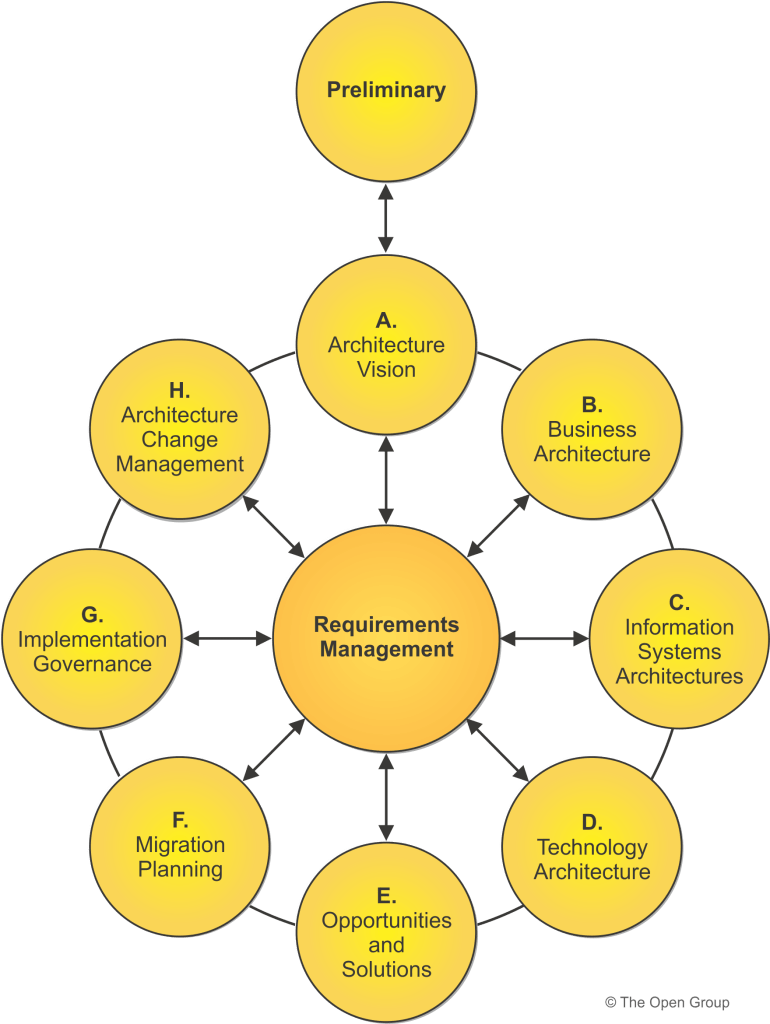
The Open Group Architectural Framework (TOFAG) is a popular framework for enterprise architecture. It recognizes that different stakeholders will find different views of the architecture helpful, as well as how the architecture will evolve over its development life-cycle as well as it evolves over future enhancements.
| Phase | Objective |
| Preliminary | – Determine the Architecture Capability desired by the organization: – Establish Capability Maturity target |
| Architecture Vision | – Develop a high-level aspirational vision of the capabilities and business value to be delivered as a result of the proposed Enterprise Architecture – Obtain approval for a Statement of Architecture Work that defines a program of works to develop and deploy the architecture outlined in the Architecture Vision |
| Business Architecture | -Develop the Target Business Architecture that describes how the enterprise needs to operate to achieve the business goals, and respond to the strategic drivers set out in the Architecture Vision, in a way that addresses the Statement of Architecture Work and stakeholder concerns – Identify candidate Architecture Roadmap components based upon gaps between the Baseline and Target Business Architectures |
| Information System Architectures | – Develop the Target Information Systems Architectures, describing how the enterprise’s Information Systems Architecture will enable the Business Architecture and the Architecture Vision, in a way that addresses the Statement of Architecture Work and stakeholder concerns – Identify candidate Architecture Roadmap components based upon gaps between the Baseline and Target Information Systems (Data and Application) Architectures |
| Technology Architecture | – Develop the Target Technology Architecture that enables the Architecture Vision, target business, data, and application building blocks to be delivered through technology components and technology services, in a way that addresses the Statement of Architecture Work and stakeholder concerns – Identify candidate Architecture Roadmap components based upon gaps between the Baseline and Target Technology Architectures |
| Opportunities and Solutions | – Generate the initial complete version of the Architecture Roadmap, based upon the gap analysis and candidate Architecture Roadmap components from Phases B, C, and D – Determine whether an incremental approach is required, and if so identify Transition Architectures that will deliver continuous business value – Define the overall Solution Building Blocks (SBBs) to finalize the Target Architecture based on the ABBs |
| Migration Planning | – Finalize the Architecture Roadmap and the supporting Implementation and Migration Plan – Ensure that the Implementation and Migration Plan is co-ordinated with the enterprise’s approach to managing and implementing change in the enterprise’s overall change portfolio – Ensure that the business value and cost of work packages and Transition Architectures is understood by key stakeholders |
| Implementation Governance | – Ensure conformance with the Target Architecture by implementation projects – Perform appropriate Architecture Governance functions for the solution and any implementation-driven architecture Change Requests |
| Architecture Change Management | – Ensure that the architecture development cycle is maintained – Ensure that the Architecture Governance Framework is executed – Ensure that the Enterprise Architecture Capability meets current requirements |
 Woolly Hat Systems